One of the interesting things about drone shows is how often people rule themselves out before they have even spoken to us.
“We’re near an airport.”
“Our venue says it doesn’t allow drones.”
“There’s a prison nearby.”
“We probably don’t have enough space.”
“The weather is too unpredictable.”
“We’ve left it too late.”
Some of those things are genuine considerations. A few can introduce significant restrictions. Occasionally, one of them really will mean that a particular show cannot happen at a particular venue.
But very few are an automatic no.
A professional drone show is not the same thing as somebody arriving with a camera drone and deciding where they would like to fly it. Sites, airspace and events are assessed properly, and where permissions or coordination are required, they form part of the planning process.
So if you are wondering whether you can have a drone light show at your venue, the best advice is simple:
Don’t rule it out yourself. Let us look at it.
1. “We’re Near an Airport, So We Can’t Have a Drone Show”
Being near an airport does not automatically prevent a drone show.
Airspace around many airports and airfields is protected by a Flight Restriction Zone. If the proposed drone operation falls within that restricted airspace, appropriate permission is required from the relevant air traffic control service or aerodrome operator.
That means there is an additional piece of aviation work to do. It does not mean that permission can never be granted.
We have previously delivered drone operations close to active airport environments by working with the relevant aviation stakeholders and agreeing how the operation can take place safely alongside other airspace users.
Every location is different, and we would never promise that an airport will approve a particular show before speaking to them. But looking at a map, seeing an airport nearby and assuming the project is impossible can rule out perfectly viable sites.
If your event is near an airport, tell us where it is and let us assess the airspace properly.
You can also read more in Can You Fly Drone Shows Near an Airport?.
2. “The Venue Doesn't Allow Drones”
This one usually deserves a conversation.
Many venues have perfectly sensible drone policies. They may have had problems with guests flying camera drones, concerns about privacy, worries about insurance or simply introduced a blanket rule because they do not want uncontrolled aircraft being flown around the property.
A professional drone light show is obviously a very different proposition.
That does not mean we can ignore the venue’s rules or that a venue is obliged to change its mind. We need the appropriate agreement to use the site, and sometimes the answer genuinely will remain no.
But we have often found that once a venue understands what is being proposed, how the operation will be managed and what information we can provide, the conversation becomes very different.
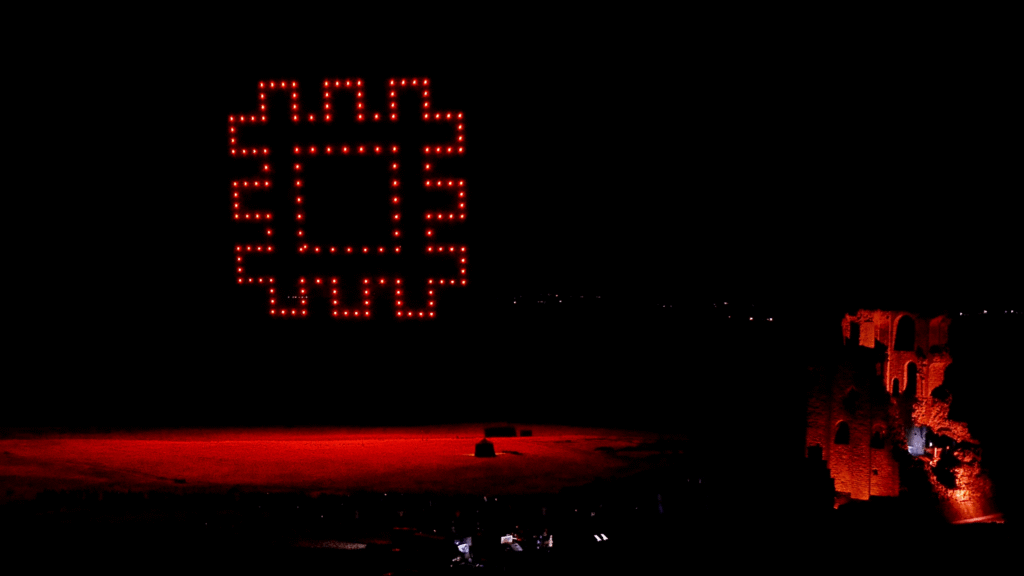
A good example from our own history is Scarborough Castle. Drone use at English Heritage properties is controlled, but with the necessary cooperation and permission we delivered a 100-drone show beside the historic castle.
So if somebody at the venue has said, “we don’t allow drones”, it is worth establishing exactly what that means before abandoning the idea.
We are very happy to speak directly with venues.
3. “We're Near a Prison”
This one is a genuine airspace restriction, so it needs to be treated seriously.
Since January 2024, closed prisons and young offender institutions in England and Wales have drone restricted airspace extending 400 metres from the protected site.
Flying a drone within that restricted airspace requires an exemption.
That still means near a prison does not necessarily mean impossible, but it can have a significant effect on the planning. The relevant authority recommends allowing at least 28 days for an exemption request, and there is no guarantee that a particular application will be approved.
The important thing is to identify the issue early.
If your proposed venue is close to a prison, tell us when you enquire. We can establish whether the planned operating area is affected and what options are realistically available.
4. “We Probably Don't Have Enough Space”
This is one of the most common assumptions, and one of the hardest to answer without actually seeing the venue.
There isn’t one universal rectangle of land that every drone show needs.
The required space depends on the aircraft, number of drones, show design, flight volume, audience position, surrounding obstacles and the operational plan for that particular project.
The obvious field immediately outside the venue is not necessarily where the drones have to launch either. Sometimes a site that initially looks awkward has a much better operating area elsewhere on the estate or surrounding land.
Conversely, a huge field is not automatically a perfect drone-show site. Power lines, roads, public access, trees, buildings, neighbouring land and the airspace above it can all matter.
This is why we prefer to assess actual venues rather than give somebody a generic minimum-area figure and tell them to measure it themselves.
Send us a postcode, a map pin or the venue details and we can usually get a useful first impression very quickly.
5. “The British Weather Makes Drone Shows Too Risky”
Weather matters. But a breezy evening or a bit of rain does not automatically mean cancelling a FlightShows performance.
We knew from the beginning that we would be operating outdoors in the UK, so we have invested heavily in aircraft designed for that environment.
Our outdoor fleet can operate in winds of up to 45 km/h and in light to moderate rain, subject to the conditions and limits of the operation.
There is still a weather limit. Every show has one, and the Remote Pilot makes the final decision about whether conditions are suitable for flight.
But our limits are deliberately substantial. In many situations, audience comfort and visibility can start becoming a problem before the weather reaches the aircraft’s operating limit.
Cloud is normally far less interesting than people expect. Fog and very poor visibility can be much more important because both the crew and audience still need to be able to see what is happening.
We have written a complete guide to this in Drone Shows and Weather: What Happens If It’s Windy, Cloudy, or Raining?.

6. “A Good Drone Show Needs Hundreds and Hundreds of Drones”
More drones give us more creative resolution.
If you want to write a long sentence across the sky, create a detailed portrait or build enormous three-dimensional structures, drone count becomes very important.
But that does not mean every good show needs 500 or 1,000 aircraft.
The creative idea matters just as much as the fleet size.
We have deliberately championed smaller, well-designed shows because we would rather create a strong 150-drone performance than add aircraft simply to make the number on a proposal look more impressive.
A clever transition, well-timed reveal or beautifully designed formation can have far more impact than a mediocre animation made with twice as many drones.
If fleet size is one of the things worrying you, have a look at How Many Drones Do I Need for a Drone Show? and Can 150 Drones Create a Great Drone Light Show?.
7. “We Can't Afford a Drone Show”
Drone shows are premium live productions, and there is no point pretending otherwise.
A bespoke show involves far more than hiring a fleet for ten minutes. There is creative development, animation, soundtrack work, aviation planning, operational preparation, specialist crew, equipment and the live delivery itself.
But there can still be ways of making a project work within a realistic budget.
The number of drones has a significant effect on cost, which is another reason good creative design matters. A strong idea does not always need the biggest possible fleet.
For public events and festivals, sponsorship can sometimes help fund a show while giving the sponsor something rather more interesting than another banner beside the stage. Repeat performances of the same production can also change the economics because much of the creative development has already been completed.
The important thing is to have an open conversation about budget early.
If the numbers simply don’t work, we would rather tell you than design something you cannot afford.
Our guide to What Affects the Cost of a Drone Light Show? explains where the money goes.

8. “We've Left It Too Late”
Ideally, speak to us early.
For a bespoke project, 8–10 weeks is a good planning window, and larger or more complicated events can benefit from considerably longer.
But don’t assume that being inside that window automatically makes the answer no.
We have delivered shows on much shorter timescales when the venue, airspace, creative requirements and wider event logistics have allowed it. In one particularly extreme example, we delivered a replacement wedding drone show in just five days after the couple’s fireworks were cancelled.
That is not a lead time we recommend planning around.
Some projects involve permissions or stakeholders with their own notice periods, and the closer the event gets, the fewer options everybody has.
But if your event is approaching, ask us rather than assuming.
The worst answer is that there genuinely isn’t enough time.
The better answer is that there is.
9. “The Legal Side Sounds Too Complicated”
From the client’s point of view, it shouldn’t need to be.
A professional outdoor drone show is a regulated aviation operation. There are operational requirements, risk assessments, airspace considerations and potentially permissions, notifications and coordination with other stakeholders.
That is our job.
FlightShows operates outdoor drone swarms under a UK Civil Aviation Authority SORA-based Operational Authorisation. For each project, we assess the site and proposed operation and determine what aviation planning and coordination are required.
There may still be things we need from you or your venue. We may need access to land, areas kept clear, event timings confirmed, security support or information from other suppliers.
But you do not need to become an aviation expert in order to book a drone show.
We lead the aviation side of the project and explain what we need from the event team as we go.
If you want to see what sits behind that work, read The Lifecycle of a Drone Show and Are Drone Shows Safe?.
So, Can You Have a Drone Show at Your Venue?
Maybe.
That might sound like an odd answer from a company that sells drone shows, but it is the useful one.
Some venues genuinely will not work. Some airspace restrictions may be impractical to overcome. Occasionally there isn’t enough room, enough time or a realistic way of managing the event safely.
But we have also delivered shows at locations where the initial reaction was:
“You’ll never get permission to do that there.”
A nearby airport, heritage property, difficult site or questionable weather forecast should start an assessment, not automatically end the conversation.
So before you cross a drone show off the list, send us the venue and date.
We’ll look at the site, the airspace and what you’re trying to achieve and give you a realistic view of what is possible.
Get in touch with FlightShows and let us take a look.