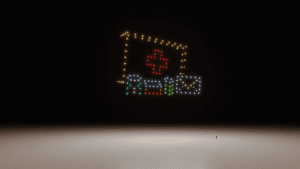
From First Enquiry to Show Night
A drone show may last around ten minutes, but the project behind it can run for weeks or months.
Before the first aircraft takes off, there can be venue assessments, airspace work, client meetings, contracts, creative development, soundtrack production, animation, operational planning, permissions, testing, logistics and coordination with the wider event team.
Some of those stages happen one after another. Many happen at the same time.
This is what goes on behind the scenes at FlightShows to turn an initial idea into a live drone show.
How Long Does It Take to Plan a Drone Show?
For most bespoke projects, 8–10 weeks is a good planning window, and longer is always welcome for larger or more complex productions.
That gives us time to properly understand the event, develop the creative, work through the aviation requirements, coordinate with the venue and other suppliers, and thoroughly prepare the finished show.
We can sometimes deliver much faster. We have certainly done it.
But if you have the luxury of planning early, use it. More time gives everybody more creative freedom and more options if something complicated emerges during the planning process.
1. The Initial Conversation: How Can We Add Value?
Every project starts with understanding the event, not just the drone show.
We want to know what is happening, who will be there, what the event is trying to achieve and where a drone show could add genuine value.
Sometimes that is obvious. The show might be the major finale of the evening, a product reveal or the centrepiece of a celebration.
Sometimes the more interesting opportunity comes out of the conversation. Perhaps the drones can tell a story that runs through the wider event, reveal something the audience does not yet know, create a moment designed for media coverage or connect several themes that already exist elsewhere in the production.
We also need to understand the practical framework: the proposed venue and date, audience size, timings, creative ambitions and budget.
That first conversation gives us the information we need to start answering two questions:
Can we do it?
And, just as importantly:
How can we make the drone show genuinely worthwhile for this event?
2. Initial Venue and Airspace Assessment
Before developing a project too far, we need to establish whether the proposed location is suitable.
We can normally begin this process remotely using mapping, aviation information, satellite imagery and details supplied by the client or venue.
We look at where the audience could be positioned, where the drones could operate, the space available for take-off and landing, surrounding obstacles and the airspace above and around the site.
Nearby airports, controlled airspace or other aviation activity do not automatically mean a drone show cannot happen. They may, however, change the way the operation needs to be planned and introduce additional coordination or permissions.
3. Building the Proposal
Once we understand the event and have an initial view of the venue, we can start turning the idea into a project.
The proposal brings together the creative and practical sides of the show. We can recommend an appropriate number of drones, discuss the likely duration and scale of the performance, outline the creative direction and identify any important production requirements.
This is also where budget and ambition meet.
More drones give us more creative resolution and allow us to produce larger or more detailed imagery, but simply increasing the drone count is not always the best use of a client’s budget.
We are trying to find the combination that creates the greatest impact for the event.
The proposal gives everyone a clear idea of what we intend to create, what will be involved in delivering it and what it will cost.
4. Confirming the Project
Once the scope is agreed, contracts are issued and the project moves into production.
At this point, the drone show becomes part of the wider event plan.
We establish responsibilities, confirm key contacts and begin coordinating with the people involved in delivering the event.
Depending on the project, that might include an event producer, venue manager, production company, security team, sound department, lighting supplier, fireworks company, local authority or other specialist contractors.
This coordination matters.
A drone show might be happening hundreds of feet above the audience, but it still has to integrate properly with everything happening on the ground.
5. Detailed Site Planning
The initial assessment tells us that a site appears viable. We then develop that into a detailed operational plan.
Depending on the venue and complexity of the project, this can involve further desk-based work, detailed information from the venue and an on-site survey where appropriate.
We consider the take-off and landing area, operational volume, audience position, separation distances, access, obstacles, security requirements, crew areas and how the operation interacts with the rest of the event site.
We also need to think about the show from the audience’s perspective.
Where will people actually stand?
What direction will they be looking?
Will buildings, trees or other structures affect the view?
Where should the show sit in the sky to create the greatest impact from the intended viewing area?
For some projects we create detailed site models which can be used by both our operational and creative teams. This helps connect what is being designed on a computer with the real place in which the audience will eventually see it.
6. Developing the Story
Once the project is established, the creative work can properly begin.
This is where we stop talking about a collection of potential drone formations and start developing a show.
We look at the event, the audience and the message we want to communicate. We identify the important moments, decide what the performance should build towards and start finding the visual language that will tell that story in the sky.
A corporate anniversary might move through decades of history. A destination show might explore local landmarks and culture. A product launch might build anticipation towards a reveal. A private celebration might tell a much more personal story.
The process is different for every project because the story should belong to the event.
We go much deeper into this side of our work in The Art of Creating a Drone Light Show, where we explain how storytelling, music, animation, transitions, lighting and pacing come together to create the finished performance.
7. Creating the Soundtrack
Music is developed alongside the visual ideas because it provides the structure on which much of the show will eventually hang.
It establishes pace, emotion and timing.
We identify the important musical moments, changes of energy and opportunities for visual reveals. Once the soundtrack is agreed, the animation team has a precise framework around which movement and lighting can be choreographed.
This is an important milestone.
Changing the soundtrack once detailed animation has begun can affect far more than the music. It can change the timing of transitions, formations, lighting cues and entire sections of the show.
So we work hard to get it right before moving too far into the animation process.
8. Storyboarding the Show
The storyboard takes the story and soundtrack and turns them into a visual plan.
It establishes what the audience will see through the different stages of the performance and how those scenes relate to the music.
This is where we can look at the show as a whole before committing to the enormous amount of work involved in detailed animation.
Does the opening work?
Are we introducing the story clearly enough?
Are there too many similar images?
Does the show have variation?
Have we saved something special for the ending?
Does each scene actually earn its place?
It is much easier to solve those questions at storyboard stage than after hundreds of flight paths have been animated.
Once the structure is agreed, we can move into full production.
9. Animation, Transitions and Lighting
This is where the storyboard becomes a drone show.
Individual formations are developed in three-dimensional space and turned into movements that real aircraft can perform.
But the finished formations are only part of the work.
We also design the transitions between them, ensuring that the audience sees one continuous piece of animation rather than drones apparently travelling from one picture to another.
The lighting is then choreographed alongside the movement and soundtrack. Colours change, elements are revealed, effects move through formations and important moments are timed precisely to the music.
This can be painstaking work.
A few seconds of finished show can represent hours of animation and refinement.
Eventually, all of those individual decisions come together into one continuous performance.
10. Aviation Planning and Coordination
While the creative show is taking shape, another major piece of work is happening in parallel.
A drone show is also an aviation operation.
The exact requirements vary considerably depending on the venue, airspace, event and nature of the proposed flight, but every project requires appropriate operational planning and risk assessment.
Where necessary, we also work through relevant permissions, notifications and coordination with airspace stakeholders.
That might involve an airport, air traffic service, landowner, venue, event organiser or other parties whose activities interact with the proposed operation.
The show also has to be integrated into the event schedule. We need an agreed flight time, the correct areas secured and appropriate procedures in place so that the operating environment matches the plan when the drones are ready to launch.
A large amount of this work happens quietly behind the scenes.
The audience will never see it.
But it is every bit as important as the animation they eventually watch.
11. Simulation, Review and Testing
Before the show reaches an audience, we review how the completed production performs as a whole.
Simulation allows us to see the show from the intended audience position and evaluate the timing, scale, formations, transitions and relationship with the soundtrack.
This can reveal things that are not obvious while working on individual scenes.
An image might need to be larger. A transition might feel too slow. A formation might need to remain visible for longer. Something that looked impressive in isolation may simply not earn its place in the finished show.
The project also goes through technical checks to prepare it for real aircraft.
Where appropriate, the show may be physically test-flown before the public performance. On some projects, aspects of testing may instead form part of the final preparations at the event site.
The exact process depends on the show, but by the time we reach the event, the team should already know the performance in considerable detail.
12. Preparing for Show Day
As the event approaches, the different strands of the project start coming together.
Final timings are confirmed with the event team. Crew arrangements and logistics are checked. Operational documentation is completed. Equipment is prepared and, as show day approaches, the latest forecasts and expected operating conditions come into sharper focus.
We make sure everyone knows what needs to happen, when it needs to happen and who is responsible for it.
This stage is less glamorous than animation or flying drones, but good live events depend on it.
The objective is to arrive on site with as few unanswered questions as possible.
13. Show Day
On show day, the project moves from planning into live operations.
The crew arrives with enough time to establish the operating area, prepare the control systems and deploy the aircraft.
Hundreds of drones have to be physically positioned. Systems are checked. Communications are established. The operating area is managed and we coordinate with the venue and wider event team as the day progresses.
Weather conditions are monitored throughout.
Before the performance, the crew works through the required checks and confirms that the conditions match the plan.
Then everything becomes very simple from the audience’s point of view.
The music starts.
The drones take off.
And weeks of meetings, planning, animation, paperwork and preparation become a show in the sky.
14. Landing, Recovery and Debrief
When the final formation disappears, our job is not quite finished.
The drones return to the operating area and land. The aircraft are accounted for, the site is made safe and the equipment is recovered.
The crew then reviews the operation.
We look at what went well, anything unexpected that happened and anything we can learn for the next project.
That feedback becomes part of the way we continually refine both our operational procedures and the way we produce shows.
Because however successful a project has been, there is nearly always something useful to learn from actually doing it.
Ten Minutes in the Sky, Weeks Behind the Scenes
When a drone show works properly, most of this is invisible.
The audience sees hundreds of lights rise into the night sky and watches a story unfold above them.
They do not see the initial feasibility work, venue plans, soundtrack edits, animation meetings, flight planning, operational documentation, simulations, logistics or hours spent preparing the aircraft.
And that is exactly how it should feel.
A drone show sits at the intersection of several very different disciplines: live events, creative production, animation, sound, aviation and technology.
All of them have to come together at exactly the right moment.
The result might only exist in the sky for ten minutes.
The lifecycle behind it is considerably longer.
If you are considering a drone show for your event, get in touch with FlightShows. The first step is simply a conversation about your event, what you want to achieve and how we might be able to add something extraordinary to it.